
Navratri 2026 – Dates, Ghatasthapana, Puja Vidhi & Significance
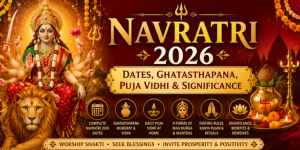
Navratri is one of the most important festivals dedicated to Goddess Durga and the divine feminine energy, Shakti. The nine nights are traditionally devoted to the worship of the nine forms of Maa Durga, collectively known as Navadurga.
According to Astroshastra, Navratri is observed twice a year as Chaitra Navratri and Sharad Navratri, with Sharad Navratri preceding Dussehra.
The festival is associated with devotion, fasting, prayer, spiritual discipline and the traditional victory of good over evil.
When is Navratri 2026?
The main Sharad Navratri 2026 dates are:
Navratri Begins: Sunday, October 11, 2026
Ghatasthapana: Sunday, October 11, 2026
Durga Ashtami: Sunday, October 18, 2026
Maha Navami: Monday, October 19, 2026
Vijayadashami / Dussehra: Tuesday, October 20, 2026
The nine Navratri days are observed from Pratipada through Navami, followed by Vijayadashami on the tenth day.
Important
Ghatasthapana Muhurat is location-specific. Therefore, devotees should check the Panchang for their city before performing Kalash Sthapana rather than using a generic national timing.
Navratri 2026 Day-Wise Dates
| Day | Date | Tithi | Goddess |
|---|---|---|---|
| Day 1 | October 11 | Pratipada | Maa Shailputri |
| Day 2 | October 12 | Dwitiya | Maa Brahmacharini |
| Day 3 | October 13 | Tritiya | Maa Chandraghanta |
| Day 4 | October 14 | Chaturthi | Maa Kushmanda |
| Day 5 | October 15 | Panchami | Maa Skandamata |
| Day 6 | October 16 | Shashthi | Maa Katyayani |
| Day 7 | October 17 | Saptami | Maa Kaalratri |
| Day 8 | October 18 | Ashtami | Maa Mahagauri |
| Day 9 | October 19 | Navami | Maa Siddhidatri |
| Day 10 | October 20 | Dashami | Vijayadashami |
The 2026 New Delhi calendar lists the nine forms from Shailputri through Siddhidatri on October 11–19, followed by Vijayadashami on October 20.
What is Navratri?
The word Navratri comes from two Sanskrit words:
Nav – Nine
Ratri – Nights
Navratri therefore means nine nights.
During these nine nights, devotees worship different manifestations of Goddess Durga.
According to Astroshastra, the nine forms are:
- Maa Shailputri
- Maa Brahmacharini
- Maa Chandraghanta
- Maa Kushmanda
- Maa Skandamata
- Maa Katyayani
- Maa Kaalratri
- Maa Mahagauri
- Maa Siddhidatri
Each form represents a different expression of Shakti and is associated with different spiritual qualities.
Spiritual Significance of Navratri
Navratri represents the worship of Shakti – divine feminine energy.
The festival is traditionally associated with the victory of Goddess Durga over the demon Mahishasura and the triumph of good over evil.
At a spiritual level, Navratri can also be understood as a period of:
- Self-discipline
- Devotion
- Inner purification
- Prayer
- Meditation
- Fasting
- Spiritual growth
- Overcoming negativity
The nine forms of Durga provide different symbolic lessons, from courage and determination to wisdom, protection and spiritual accomplishment.
Ghatasthapana During Navratri
Ghatasthapana, also called Kalash Sthapana, marks the beginning of Navratri worship.
A Kalash is traditionally established in the Puja area and Goddess Shakti is invoked.
Astroshastra describes Ghatasthapana as one of the most significant rituals of Navratri and provides a detailed Navratri Puja Procedure.
Traditional Ghatasthapana may involve:
- Kalash
- Water
- Mango leaves
- Coconut
- Rice
- Moli
- Roli
- Flowers
- Barley seeds
- Diya
- Incense
The exact procedure may vary according to regional and family traditions.
How to Perform Ghatasthapana?
A traditional Kalash Sthapana may be performed in the following sequence:
1. Clean the Puja Area
Clean the place where the Navratri Kalash will be established.
2. Take a Bath
Devotees traditionally bathe and wear clean clothes before beginning the Puja.
3. Prepare the Kalash
Fill the Kalash with clean water and place the prescribed leaves and coconut according to your tradition.
4. Establish the Kalash
Place the Kalash at the designated Puja location.
5. Sow Barley
In many traditions, barley seeds are sown around the Kalash as part of Ghatasthapana.
6. Invoke Goddess Durga
Perform Sankalp and invoke Maa Durga with devotion.
7. Light the Diya
A lamp is traditionally lit during the worship.
Astroshastra's Navratri Puja Vidhi provides a detailed list of Puja materials and step-by-step instructions.
Navratri Puja Vidhi
A simple daily Navratri Puja can include:
- Wake up early.
- Take a bath and wear clean clothes.
- Clean the Puja area.
- Light a Diya.
- Offer flowers to Maa Durga.
- Offer incense.
- Offer fruits or traditional Bhog.
- Chant the relevant Navdurga mantra.
- Recite Durga Chalisa or Durga Saptashati according to your practice.
- Perform Durga Aarti.
- Pray for the well-being of your family.
Astroshastra's Navratre Puja Procedure provides a detailed traditional procedure, including Puja materials, Kalash Sthapana and daily worship.
Day 1 – Maa Shailputri
The first day of Navratri is dedicated to Maa Shailputri, the first form of Navadurga.
Maa Shailputri is traditionally associated with strength, purity and stability.
Astroshastra explains that Shailputri is the daughter of the mountain and a manifestation of Goddess Parvati. Its dedicated Maa Shailputri article also discusses her mantra and Puja Vidhi.
Day 2 – Maa Brahmacharini
The second day is dedicated to Maa Brahmacharini.
She represents penance, devotion, determination and spiritual discipline.
Astroshastra's Maa Brahmacharini article explains her significance, symbolism, mantra and traditional offerings.
Day 3 – Maa Chandraghanta
The third day is dedicated to Maa Chandraghanta.
She represents courage, protection and divine strength.
Devotees traditionally worship her for peace, courage and protection from negative influences.
Day 4 – Maa Kushmanda
The fourth day is dedicated to Maa Kushmanda.
She is traditionally associated with creative energy, vitality and the cosmic power of Shakti.
Day 5 – Maa Skandamata
The fifth day is dedicated to Maa Skandamata.
She is worshipped as the mother of Lord Skanda or Kartikeya and represents maternal love, protection and compassion.
Day 6 – Maa Katyayani
The sixth day is dedicated to Maa Katyayani.
She is particularly associated in Hindu tradition with strength and the fulfilment of certain devotional prayers.
Maa Katyayani worship is also traditionally associated with prayers concerning marriage.
Day 7 – Maa Kaalratri
The seventh day is dedicated to Maa Kaalratri.
She represents the powerful and fierce aspect of Shakti.
Devotees traditionally worship her for protection, courage and removal of fear.
Day 8 – Maa Mahagauri
The eighth day is dedicated to Maa Mahagauri.
Durga Ashtami falls on October 18, 2026. The 2026 calendar lists Mahagauri Puja along with Durga Ashtami on this day.
Many families perform Kanya Puja on Ashtami or Navami according to their tradition.
Day 9 – Maa Siddhidatri
The ninth day is dedicated to Maa Siddhidatri.
Maha Navami falls on October 19, 2026. The day is also associated with Navami Homa and other regional Navratri observances.
Maa Siddhidatri represents spiritual accomplishment and divine grace.
Navratri Fasting
Many devotees observe fasting during Navratri.
The rules of fasting differ considerably between individuals and traditions.
Common fasting foods may include:
- Fruits
- Milk
- Sabudana
- Kuttu
- Singhara
- Samak rice
- Potatoes
- Nuts
- Rock salt
Some devotees observe a complete fast, while others follow a restricted diet.
Fasting should be undertaken according to one's health, age and personal circumstances.
Astroshastra also discusses Navratri Significance, Fasting Rules & Spiritual Benefits.
Kanya Puja During Navratri
Kanya Puja is traditionally performed on Ashtami or Navami in many Hindu families.
Young girls are symbolically worshipped as manifestations of the Divine Mother.
They may be offered:
- Food
- Sweets
- Fruits
- Gifts
- Clothes
- Dakshina
The exact number of girls and the procedure can vary according to regional and family customs.
Navratri Mantras
Devotees may chant the mantra associated with each form of Navadurga.
Devotees may also recite:
- Durga Chalisa
- Durga Saptashati
- Navdurga Stotra
- Devi mantras
- Durga Aarti
Astroshastra's Navratri resources provide additional information on Navratri Mantras and Puja.
Navratri Remedies According to Astrology
Navratri is also considered an auspicious period for spiritual remedies in Vedic astrology.
Astroshastra's Remedies for Navratre in Indian Astrology discusses traditional remedies involving:
- Mantra chanting
- Fasting
- Charity
- Puja
- Goddess worship
- Spiritual practices
The article also discusses Navratri remedies for health, prosperity, protection and spiritual development.
Remedies should ideally be selected according to an individual's horoscope rather than following the same remedy for everyone.
Navratri and Astrology
Navratri has an important place in the spiritual side of Vedic astrology because it is associated with Shakti worship and the nine forms of Goddess Durga.
For someone experiencing planetary challenges, Navratri may be used as a period for additional prayer, mantra, charity and spiritual discipline.
However, astrological remedies should be chosen after examining the birth chart.
If you want to understand which planetary influences are affecting your life, you can Get Your Horoscope Analysed by an Astro Expert at Astroshastra.
Navratri and the Nine Forms of Shakti
The nine forms of Durga can be viewed as nine expressions of divine energy:
| Day | Goddess | Associated Quality |
|---|---|---|
| 1 | Shailputri | Stability & strength |
| 2 | Brahmacharini | Devotion & determination |
| 3 | Chandraghanta | Courage & protection |
| 4 | Kushmanda | Creative energy |
| 5 | Skandamata | Motherly protection |
| 6 | Katyayani | Strength & courage |
| 7 | Kaalratri | Fearlessness & protection |
| 8 | Mahagauri | Purity & peace |
| 9 | Siddhidatri | Spiritual accomplishment |
Navratri Puja at Home
Navratri worship does not necessarily have to be elaborate.
A simple home observance can include:
Cleanliness → Kalash Sthapana → Daily Diya → Durga Puja → Mantra → Bhog → Aarti → Charity
The most important element is devotion.
Astroshastra's detailed Navratre Puja Procedure can be used as a reference for the traditional materials and steps.
Navratri and Charity
Charity and Seva are meaningful practices during Navratri.
Devotees may donate:
- Food
- Clothes
- Grains
- Money
- Educational materials
- Essential items
The purpose should be genuine service rather than simply performing a ritual for personal gain.
Navratri Products & Spiritual Items
Astroshastra's Navratri resource also highlights traditional spiritual products associated with Goddess worship, including:
- Nine Mukhi Rudraksha
- Durga Pendant
- Navdurga Shakti Pendant
- Maa Kali Pendant
- Siddh Durga Mala
- Durga Yantra
- Bisa Yantra
- Ambaji Yantra
- Durga Chalisa
- Rudraksha Durga Pendant
These can be explored as complementary devotional items, but any gemstone or Rudraksha recommended specifically for astrological purposes should ideally be selected after examining the horoscope.
What Should You Avoid During Navratri?
Practices vary by family and tradition, but devotees commonly try to maintain:
- Cleanliness
- Sattvic food
- Self-discipline
- Prayer
- Respectful behaviour
- Control over anger
- Avoidance of unnecessary negativity
- Regular spiritual practice
Navratri is ideally treated as a period of inner purification as well as external worship.
Navratri 2026 – Important Dates at a Glance
October 11, 2026 – Sunday: Ghatasthapana & Maa Shailputri
October 12 – Monday: Maa Brahmacharini
October 13 – Tuesday: Maa Chandraghanta
October 14 – Wednesday: Maa Kushmanda
October 15 – Thursday: Maa Skandamata
October 16 – Friday: Maa Katyayani
October 17 – Saturday: Maa Kaalratri
October 18 – Sunday: Durga Ashtami & Maa Mahagauri
October 19 – Monday: Maha Navami & Maa Siddhidatri
October 20 – Tuesday: Vijayadashami / Dussehra
Why Should You Observe Navratri?
Navratri offers an opportunity to dedicate nine days to:
Faith – Discipline – Prayer – Shakti – Self-improvement
Whether you observe a strict fast, perform a simple Puja at home, recite Durga mantras or simply spend a few minutes each day in prayer, the essence of Navratri is devotion and connection with the Divine Mother.
Navratri 2026 begins on October 11 and culminates in Vijayadashami on October 20.
The nine nights are dedicated to the nine forms of Maa Durga, beginning with Shailputri and ending with Siddhidatri.
For devotees, Navratri is a time to seek the blessings of Shakti, overcome negativity, develop inner strength and renew spiritual discipline.
For those following Vedic astrology, it can also be a meaningful period for traditional remedies, mantra chanting and charitable activities.
Most importantly, Navratri reminds us that divine strength is not only something we worship outside ourselves — it is also something we cultivate within.
Want to Know Which Navratri Remedy is Suitable for You?
Every horoscope is different. A remedy that is beneficial for one person may not be appropriate for another.
If you are facing difficulties related to career, marriage, finances, health, relationships or planetary afflictions, get your birth chart analysed before choosing an astrological remedy.
Get Your Horoscope Analysed by an Astro Expert at Astroshastra.
Frequently Asked Questions – Navratri 2026
1. When does Navratri 2026 begin?
Sharad Navratri 2026 begins on Sunday, October 11, 2026, with Pratipada and Ghatasthapana.
2. When is Ghatasthapana in 2026?
Ghatasthapana will be performed on October 11, 2026. The exact Muhurat should be checked according to your city because Panchang timings are location-specific.
3. When is Durga Ashtami in 2026?
Durga Ashtami falls on Sunday, October 18, 2026.
4. When is Maha Navami in 2026?
Maha Navami falls on Monday, October 19, 2026.
5. When is Dussehra in 2026?
Vijayadashami or Dussehra will be observed on Tuesday, October 20, 2026.
6. Which Goddess is worshipped on the first day of Navratri?
The first day is dedicated to Maa Shailputri, the first form of Navadurga.
7. How many forms of Goddess Durga are worshipped during Navratri?
Nine forms, collectively called Navadurga, are worshipped during the nine nights.
8. Can Navratri Puja be performed at home?
Yes. Devotees can perform Navratri Puja at home according to their family tradition. Astroshastra provides a detailed Navratri Puja Procedure.
9. What is Ghatasthapana?
Ghatasthapana or Kalash Sthapana is the traditional ritual of establishing the sacred Kalash and invoking Goddess Shakti at the beginning of Navratri.
10. What are the Navratri fasting rules?
Fasting rules vary by tradition. Devotees may observe a complete fast or consume permitted fasting foods such as fruits, milk, sabudana, kuttu and samak rice.
11. Which mantra should I chant during Navratri?
You can chant the mantra of the particular form of Maa Durga worshipped that day. For example, Maa Shailputri's mantra is Om Devi Shailputryai Namah.
12. Are Navratri remedies useful in astrology?
Navratri is traditionally considered an auspicious period for spiritual remedies. Astroshastra provides a dedicated resource on Navratri Remedies in Indian Astrology.