
Hartalika Teej – Vrat Vidhi, Katha, Puja, Significance & Benefits
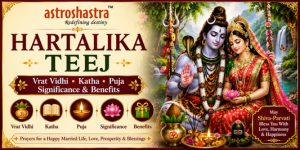
It is traditionally observed by women with prayers for marital happiness, the well-being and longevity of their husbands and harmony in family life.
Unmarried women may also observe Hartalika Teej and pray for a suitable and loving life partner.
The festival is particularly associated with the intense devotion and penance of Goddess Parvati, who is traditionally believed to have performed severe austerities to attain Lord Shiva as her husband.
Astroshastra's Teej resource describes Hartalika Teej as the most significant form of Teej and connects it with Goddess Parvati's penance and devotion to Lord Shiva.
Why is Hartalika Teej Celebrated?
Hartalika Teej is traditionally observed to seek the blessings of Lord Shiva and Goddess Parvati.
Married women may pray for:
- Long life and good health of their husbands
- Marital happiness
- Family prosperity
- Harmony in married life
- Emotional strength
- Peace within the family
Unmarried women may observe the Vrat with the traditional wish of finding a suitable life partner.
The deeper purpose of the festival is devotion, self-discipline, faith and the celebration of the divine union of Shiva and Parvati.
Hartalika Teej and Goddess Parvati
The central story behind Hartalika Teej is associated with Goddess Parvati's unwavering determination to marry Lord Shiva.
According to traditional belief, Parvati desired Lord Shiva as her husband. She undertook severe penance and devoted herself completely to Shiva.
Her father, however, wished to marry her to another suitable prince.
Parvati continued her devotion and eventually sought refuge in a secluded forest, where she continued her austerities.
Her determination and devotion ultimately led to her union with Lord Shiva.
This story is the spiritual foundation of Hartalika Teej and represents:
Devotion • Determination • Faith • Sacrifice • Love
Why is it Called Hartalika Teej?
The name Hartalika is traditionally associated with the story of Goddess Parvati being taken away by her companion to protect her from being married against her wishes.
The word is commonly explained through the combination of terms associated with taking away and female companionship.
Thus, the story of Parvati's friend helping her escape to the forest is closely connected with the name Hartalika.
Hartalika Teej Vrat
Hartalika Teej is traditionally known for its strict fasting practices.
Many women observe a Nirjala Vrat, meaning they refrain from both food and water for the prescribed period.
However, fasting practices differ according to individual health, family customs and regional traditions.
The spiritual purpose of fasting is to develop:
- Self-control
- Concentration
- Devotion
- Patience
- Mental discipline
A strict fast should not be undertaken if it could adversely affect one's health. Those who cannot safely observe a Nirjala Vrat can follow a suitable alternative according to their family or spiritual tradition.
Hartalika Teej Puja Vidhi
A traditional Hartalika Teej Puja can be performed at home with devotion.
1. Clean the Puja Area
Clean the house and prepare a dedicated Puja space.
2. Take a Bath
Take a bath and wear clean or traditional festive clothes.
3. Take the Vrat Sankalp
Take a Sankalp to observe the Hartalika Teej Vrat according to your tradition.
4. Prepare Shiva and Parvati
Place idols or images of Lord Shiva and Goddess Parvati.
Traditionally, some devotees make symbolic clay images of Shiva and Parvati for the Puja.
5. Light a Diya
Light a Diya and incense before the deities.
6. Offer Puja Samagri
Offer traditional items such as:
- Flowers
- Bilva leaves
- Akshat
- Kumkum
- Roli
- Fruits
- Sweets
- Water
- Milk
- Dhoop
- Deep
7. Worship Shiva and Parvati
Perform Shiva-Parvati Puja with devotion.
8. Read Hartalika Teej Vrat Katha
Read or listen to the traditional Vrat Katha.
9. Chant Mantras
Chant Shiva and Parvati Mantras.
10. Perform Aarti
Complete the Puja with Aarti and prayers.
Hartalika Teej Vrat Katha
The traditional Hartalika Teej Katha revolves around Goddess Parvati's determination to attain Lord Shiva as her husband.
Parvati was deeply devoted to Shiva and performed intense austerities.
Her father wanted her to marry another suitable man, but Parvati did not wish to abandon her devotion to Shiva.
According to the traditional story, one of her close companions took her away to a secluded forest so that she could continue her penance without interference.
Parvati continued her worship and austerities with complete dedication.
Eventually, Lord Shiva accepted her devotion and agreed to marry her.
The story represents the victory of faith, determination and sincere devotion.
Spiritual Significance of Hartalika Teej
Hartalika Teej carries several important spiritual messages.
Devotion
Parvati's devotion demonstrates the power of sincere spiritual dedication.
Determination
The story teaches that genuine goals require patience and perseverance.
Self-Discipline
The Vrat encourages control over the senses and concentration of the mind.
Marital Harmony
The festival is traditionally associated with prayers for a happy and harmonious married life.
Feminine Strength
Goddess Parvati represents Shakti — divine feminine strength, courage and determination.
Hartalika Teej and Lord Shiva
Lord Shiva is worshipped along with Goddess Parvati during Hartalika Teej.
Devotees may offer:
- Water
- Milk
- Bilva leaves
- Flowers
- Fruits
- Dhoop
- Deep
- Sweets
A simple and widely known Shiva Mantra is:
Om Namah Shivaya
Devotees may chant the Mantra according to their spiritual practice.
Hartalika Teej and Goddess Parvati
Goddess Parvati is the principal feminine deity associated with Hartalika Teej.
She represents:
- Shakti
- Love
- Devotion
- Marriage
- Patience
- Determination
- Strength
- Family harmony
Women traditionally seek her blessings for happiness and stability in married life.
Hartalika Teej for Married Women
Married women traditionally observe Hartalika Teej with prayers for:
- Husband's longevity
- Husband's health
- Marital happiness
- Family prosperity
- Peace in the household
- Strong emotional bonds
Women may dress in traditional clothing, apply mehendi and participate in group celebrations.
Teej celebrations traditionally include colourful clothing, jewellery, mehendi, songs, dances and swings.
Hartalika Teej for Unmarried Women
Unmarried women may also observe Hartalika Teej.
They traditionally pray to Goddess Parvati and Lord Shiva for:
- A suitable life partner
- A loving marriage
- Compatibility
- Marital happiness
- A harmonious family life
The devotion of Parvati is considered an important spiritual example for women observing the Vrat.
Hartalika Teej Rituals and Traditions
Traditional celebrations can include:
Mehendi
Women apply Mehendi on their hands as part of the festive celebrations.
Traditional Clothing
Women commonly wear colourful sarees or other traditional clothing.
Jewellery and Bangles
Traditional jewellery and bangles form part of the festive appearance.
Swings
Decorated swings are associated with Teej celebrations.
Songs
Women gather together and sing traditional Teej songs.
Shiva-Parvati Puja
Devotees worship the divine couple and seek their blessings.
Hartalika Teej Mantra
The simplest Shiva Mantra for devotees is:
Om Namah Shivaya
Devotees may also recite prayers dedicated to Goddess Parvati.
Those following a particular spiritual tradition may use the Mantras prescribed by their Guru or family tradition.
What to Offer During Hartalika Teej Puja?
Traditional Puja offerings may include:
- Bilva leaves
- Flowers
- Fruits
- Milk
- Water
- Akshat
- Kumkum
- Roli
- Sweets
- Dhoop
- Diya
Regional traditions may include additional offerings.
What Should Be Avoided During Hartalika Teej?
Those observing the Vrat traditionally try to maintain purity in their thoughts, words and actions.
Devotees may avoid:
- Anger
- Arguments
- Negative speech
- Excessive material indulgence
- Non-vegetarian food
- Alcohol
- Tobacco
The emphasis should remain on prayer, devotion, self-control and positive thoughts.
Hartalika Teej and Monsoon
Hartalika Teej falls during the monsoon period and forms part of India's broader Teej festival traditions.
The season is traditionally associated with:
- Greenery
- Rain
- Swings
- Folk songs
- Family gatherings
- Traditional celebrations
This gives Hartalika Teej both a religious and cultural dimension.
Hartalika Teej and Astrology
Hartalika Teej is primarily a religious Vrat, rather than an astrological remedy.
However, Vedic Astrology can be used to analyse marriage and relationship matters through an individual's birth chart.
An astrologer may examine:
- 7th House
- 7th Lord
- Venus
- Jupiter
- Navamsa Chart
- Planetary Dashas
- Marriage Yogas
- Relevant planetary influences
Therefore, if someone wants to understand their individual marriage prospects, a personalised horoscope analysis is more appropriate than relying only on a general festival remedy.
Astroshastra provides personalised horoscope consultation and relationship-related guidance.
Get Your Horoscope Analysed by an Astro Expert at Astroshastra
Hartalika Teej and Marital Harmony
The spiritual message of Hartalika Teej extends beyond the Vrat itself.
It encourages couples and families to value:
- Love
- Trust
- Patience
- Mutual respect
- Understanding
- Commitment
- Emotional support
The festival can therefore serve as an opportunity to reflect on the importance of maintaining harmony in relationships.
Charity on Hartalika Teej
Devotees may also include Daan and Seva as part of their spiritual observance.
Depending on one's capacity, one may donate:
- Food
- Clothes
- Fruits
- Sweets
- Essential items
- Money
Charity should ideally be performed with compassion and without expectation of reward.
How to Celebrate Hartalika Teej at Home
A simple home observance may follow these steps:
Morning:
Take a bath, wear clean clothes and take the Vrat Sankalp.
During the Day:
Observe your chosen form of fasting and spend time in prayer and devotional activities.
Evening:
Prepare the Shiva-Parvati Puja and arrange the traditional Puja Samagri.
Puja:
Perform Shiva-Parvati worship, read the Hartalika Teej Vrat Katha and chant Mantras.
Aarti:
Complete the Puja with Aarti and prayers.
Throughout the Festival:
Maintain a peaceful and devotional atmosphere.
Hartalika Teej – Important Symbols
| Symbol | Traditional Meaning |
|---|---|
| Lord Shiva | Divine consciousness and strength |
| Goddess Parvati | Shakti, devotion and marital harmony |
| Bilva Leaves | Traditional Shiva offering |
| Mehendi | Beauty and auspicious celebration |
| Bangles | Auspiciousness and married life |
| Swings | Joy of the monsoon |
| Vrat | Self-discipline and devotion |
| Diya | Divine light |
Hartalika Teej and Other Teej Festivals
Hartalika Teej is one of the three major forms of Teej commonly discussed in Hindu traditions.
Hariyali Teej
Associated with the monsoon season, greenery, swings and Shiva-Parvati worship.
Kajari Teej
Associated with the Bhadrapada season, folk songs and Shiva-Parvati devotion.
Hartalika Teej
Especially associated with Goddess Parvati's penance and her determination to marry Lord Shiva.
Astroshastra's Teej Festival page discusses these different forms and their traditions.
Frequently Asked Questions About Hartalika Teej
What is Hartalika Teej?
Hartalika Teej is a Hindu festival dedicated to Lord Shiva and Goddess Parvati. It is traditionally observed by women through fasting, Puja and prayers for marital happiness and family prosperity.
Why is Hartalika Teej celebrated?
It is celebrated to honour Goddess Parvati's devotion and penance for Lord Shiva and to seek blessings for a happy and harmonious married life.
Who can observe Hartalika Teej?
Married women traditionally observe the Vrat, while unmarried women may also observe it according to their family and regional traditions.
What is the Hartalika Teej Vrat?
It is a devotional fast observed in honour of Lord Shiva and Goddess Parvati. Some devotees observe a strict Nirjala fast, while others follow a form of fasting appropriate to their health and tradition.
What is the Hartalika Teej Vrat Katha?
The traditional Katha describes Goddess Parvati's intense penance and determination to marry Lord Shiva despite opposition from her father.
What is the main Hartalika Teej Mantra?
A simple and widely used Shiva Mantra is:
Om Namah Shivaya.
What should be offered to Lord Shiva on Hartalika Teej?
Devotees may traditionally offer water, milk, Bilva leaves, flowers, fruits and other appropriate Puja offerings.
Can unmarried women observe Hartalika Teej?
Yes. Unmarried women may observe Hartalika Teej according to their family tradition and pray for a suitable life partner and happy married life.
Can Hartalika Teej be observed without a Nirjala fast?
Yes. People who cannot safely undertake a strict fast may follow a suitable alternative while maintaining the devotional aspects of the observance.
Is Hartalika Teej an astrological remedy?
Hartalika Teej is primarily a religious and spiritual observance. Marriage-related astrological questions should ideally be assessed through an individual's complete horoscope.
What is the spiritual message of Hartalika Teej?
Hartalika Teej represents devotion, determination, faith, feminine strength, love and marital harmony.
Hartalika Teej is a deeply devotional festival celebrating the divine union of Lord Shiva and Goddess Parvati.
The story of Goddess Parvati's determination and penance teaches the importance of faith, patience, devotion and perseverance.
For married women, the Vrat traditionally represents prayers for the well-being of their husbands and harmony in family life. For unmarried women, it can represent prayers for a suitable and compatible life partner.
Beyond fasting and rituals, the deeper message of Hartalika Teej is to cultivate love, commitment, self-discipline and spiritual strength.
May Lord Shiva and Goddess Parvati bless devotees with love, harmony, wisdom and prosperity.