
Nav Durga: 9 Forms of Maa Durga and Their Significance
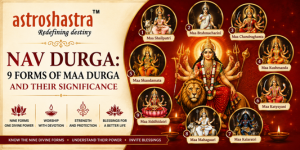
Each form represents a different expression of Shakti, the divine feminine power, and carries its own spiritual symbolism, qualities and blessings.
The worship of Nav Durga is not only a religious tradition but also a symbolic journey of purification, courage, devotion, wisdom and spiritual awakening.
During Navratri, devotees traditionally worship one form of Maa Durga each day, beginning with Maa Shailputri and concluding with Maa Siddhidatri on Navami.
Who Are the Nav Durga?
The nine forms of Maa Durga are:
- Maa Shailputri
- Maa Brahmacharini
- Maa Chandraghanta
- Maa Kushmanda
- Maa Skandamata
- Maa Katyayani
- Maa Kalaratri
- Maa Mahagauri
- Maa Siddhidatri
Together, these nine forms represent the different dimensions of Shakti — from stability and devotion to courage, purification, wisdom and spiritual accomplishment.
1. Maa Shailputri – The Goddess of Strength and Stability
Shailputri means "Daughter of the Mountain." She is traditionally regarded as the first form of Maa Durga worshipped on the first day of Navratri.
Maa Shailputri is depicted riding a bull (Nandi) and carrying a trident and lotus in her hands.
Spiritual Significance
Shailputri represents strength, stability, purity and the foundation of spiritual life.
Her worship encourages devotees to develop a strong foundation in life and remain steady even when circumstances become difficult.
What Maa Shailputri Symbolizes
- Stability
- Inner strength
- Determination
- Purity
- Emotional balance
- Connection with nature
The first day of Navratri therefore begins with establishing inner stability and strength.
2. Maa Brahmacharini – The Goddess of Devotion and Discipline
On the second day of Navratri, devotees worship Maa Brahmacharini.
She is traditionally depicted walking barefoot while holding a rudraksha mala and kamandalu.
The name Brahmacharini is associated with spiritual discipline, austerity and devotion.
Spiritual Significance
Brahmacharini represents the power of penance, patience and unwavering determination.
Her story is traditionally associated with the severe penance performed by Goddess Parvati to attain Lord Shiva as her husband.
What Maa Brahmacharini Symbolizes
- Devotion
- Patience
- Self-control
- Determination
- Spiritual discipline
- Knowledge
Her worship reminds us that meaningful achievements often require patience and sustained effort.
3. Maa Chandraghanta – The Goddess of Courage and Protection
The third form is Maa Chandraghanta.
She is recognized by the crescent moon shaped like a bell on her forehead, which gives her the name Chandraghanta.
She is traditionally depicted riding a tiger and carrying various divine weapons.
Spiritual Significance
Chandraghanta represents courage, protection and the destruction of fear.
Her fierce yet compassionate form reminds devotees that spiritual strength can help overcome fear and adversity.
What Maa Chandraghanta Symbolizes
- Courage
- Protection
- Fearlessness
- Peace
- Strength
- Divine awareness
Her worship is particularly associated with developing the courage to face life's challenges.
4. Maa Kushmanda – The Goddess of Cosmic Energy
The fourth form of Nav Durga is Maa Kushmanda.
The name Kushmanda is traditionally associated with the cosmic creative energy of the Goddess.
She is often depicted with eight arms, which is why she is also known as Ashtabhuja Devi.
Spiritual Significance
Maa Kushmanda represents creative energy, vitality and the power of creation.
Her worship is associated with bringing positive energy into one's life and overcoming darkness through divine consciousness.
What Maa Kushmanda Symbolizes
- Creation
- Vitality
- Energy
- Prosperity
- Positive consciousness
- Radiance
Her form reminds us that the universe itself is sustained through divine creative energy.
5. Maa Skandamata – The Goddess of Motherly Compassion
The fifth form is Maa Skandamata.
She is traditionally depicted holding Lord Skanda (Kartikeya) in her lap and riding a lion.
Spiritual Significance
Skandamata represents motherly love, compassion, protection and nurturing energy.
Her worship reminds devotees of the unconditional love and protective nature of the Divine Mother.
What Maa Skandamata Symbolizes
- Motherhood
- Compassion
- Protection
- Love
- Peace
- Nurturing energy
Devotees seek her blessings for family harmony, emotional strength and protection.
6. Maa Katyayani – The Goddess of Courage and Victory
The sixth form of Nav Durga is Maa Katyayani.
She is traditionally depicted riding a lion and carrying divine weapons.
Her name is associated with the sage Katyayana, in whose tradition she is said to have manifested.
Spiritual Significance
Katyayani represents courage, determination and victory over negative forces.
She is particularly associated with the power required to confront obstacles and injustice.
What Maa Katyayani Symbolizes
- Courage
- Victory
- Determination
- Protection
- Justice
- Empowerment
In some Hindu traditions, unmarried girls worship Maa Katyayani seeking blessings for a suitable marriage.
7. Maa Kalaratri – The Fierce Destroyer of Negativity
The seventh form is Maa Kalaratri, traditionally regarded as one of the most fierce manifestations of Durga.
Although her appearance is formidable, she is regarded as a compassionate protector of her devotees.
Spiritual Significance
Kalaratri represents the destruction of fear, darkness, ignorance and negative forces.
Her fierce appearance symbolizes the power required to confront the deepest forms of negativity.
What Maa Kalaratri Symbolizes
- Fearlessness
- Protection
- Destruction of negativity
- Spiritual strength
- Transformation
- Liberation from fear
Her worship teaches that confronting darkness with courage can lead to spiritual transformation.
8. Maa Mahagauri – The Goddess of Purity and Peace
The eighth form of Nav Durga is Maa Mahagauri.
Her name means "Extremely Fair" or "Greatly Radiant." She is traditionally depicted wearing white garments and riding a bull.
Spiritual Significance
Mahagauri represents purity, peace, serenity and spiritual cleansing.
Her form is associated with the purification of thoughts and the removal of accumulated negativity.
What Maa Mahagauri Symbolizes
- Purity
- Peace
- Forgiveness
- Serenity
- Spiritual cleansing
- Compassion
After the fierce transformative energy represented by Kalaratri, Mahagauri symbolizes the emergence of peace and purity.
9. Maa Siddhidatri – The Goddess of Spiritual Accomplishment
The ninth and final form is Maa Siddhidatri.
She is traditionally worshipped on Navami, the ninth day of Navratri.
Maa Siddhidatri is associated with siddhis, or spiritual accomplishments and divine attainments.
Spiritual Significance
Siddhidatri represents the culmination of the spiritual journey.
Her worship symbolizes wisdom, spiritual realization, divine grace and completeness.
What Maa Siddhidatri Symbolizes
- Spiritual accomplishment
- Wisdom
- Divine grace
- Meditation
- Higher consciousness
- Fulfilment
The journey that began with the stability of Shailputri culminates in the spiritual wisdom represented by Siddhidatri.
Nav Durga and the Spiritual Journey
The nine forms of Maa Durga can be understood as stages of inner transformation.
| Day | Form of Maa Durga | Spiritual Quality |
|---|---|---|
| 1 | Shailputri | Strength and stability |
| 2 | Brahmacharini | Devotion and discipline |
| 3 | Chandraghanta | Courage and protection |
| 4 | Kushmanda | Creative energy |
| 5 | Skandamata | Compassion and motherhood |
| 6 | Katyayani | Courage and victory |
| 7 | Kalaratri | Destruction of negativity |
| 8 | Mahagauri | Purity and peace |
| 9 | Siddhidatri | Wisdom and spiritual accomplishment |
This makes Nav Durga worship a symbolic journey from grounding to spiritual realization.
Why Are Nav Durga Worshipped During Navratri?
Navratri provides nine sacred nights for devotees to focus on different aspects of Shakti.
The nine forms remind us that divine feminine energy is not limited to one quality. It can manifest as:
Motherhood, courage, wisdom, protection, creativity, discipline, purity and spiritual power.
By worshipping the Nav Durga, devotees seek not only external blessings but also the development of these qualities within themselves.
Nav Durga and Shakti
In Hindu philosophy, Shakti represents divine energy and power.
Maa Durga is one of the most important manifestations of this divine feminine principle. Her different forms demonstrate that strength can express itself in many ways.
Sometimes Shakti appears as a loving mother.
Sometimes she appears as a fierce protector.
Sometimes she represents knowledge and spiritual discipline.
And sometimes she represents peace and divine grace.
The Nav Durga therefore provide a powerful spiritual framework for understanding the many dimensions of Shakti.
How to Worship Nav Durga During Navratri
Devotees may follow different traditions depending on their family, region and spiritual lineage. Common practices include:
Lighting a Diya
Lighting a diya before Maa Durga is a simple way of creating a sacred atmosphere and focusing the mind during prayer.
Offering Flowers
Flowers are traditionally offered to the Goddess as an expression of devotion and surrender.
Mantra Chanting
Devotees may chant Durga mantras, Devi mantras or other prayers according to their tradition.
Reading Devi Scriptures
Many devotees read or listen to Durga Saptashati (Devi Mahatmya) during Navratri.
Fasting
Many people observe Navratri vrat as a practice of discipline, devotion and self-control.
Kanya Puja
In several traditions, young girls are honoured as manifestations of the Divine Feminine, particularly on Ashtami or Navami.
The Deeper Message of Nav Durga
The worship of Nav Durga carries a profound message for modern life.
We all experience fear, uncertainty, attachment, anger, confusion and obstacles. The nine forms of Maa Durga provide symbolic reminders of the qualities needed to overcome these challenges.
Shailputri teaches stability.
Brahmacharini teaches discipline.
Chandraghanta teaches courage.
Kushmanda teaches creativity.
Skandamata teaches compassion.
Katyayani teaches determination.
Kalaratri teaches fearlessness.
Mahagauri teaches purity.
Siddhidatri teaches spiritual wisdom.
Together, they remind us that true strength is both powerful and compassionate.
The Nav Durga — nine forms of Maa Durga — represent the many dimensions of divine feminine power. Their worship during Navratri is a sacred tradition that encourages devotees to develop strength, devotion, courage, compassion, purity and wisdom.
The nine nights can be viewed as an inner journey: beginning with stability and discipline, moving through courage and transformation, and ultimately reaching peace, wisdom and spiritual accomplishment.
Nav Durga worship therefore has significance far beyond ritual. It invites us to recognize Shakti within ourselves and use that inner power to overcome negativity, develop positive qualities and move towards spiritual growth.
FAQ
What are the 9 forms of Maa Durga?
The nine forms are Maa Shailputri, Maa Brahmacharini, Maa Chandraghanta, Maa Kushmanda, Maa Skandamata, Maa Katyayani, Maa Kalaratri, Maa Mahagauri and Maa Siddhidatri.
Why are the nine forms of Maa Durga worshipped during Navratri?
Each form represents a different aspect of Shakti and a particular spiritual quality. Worshipping them over nine days symbolizes a journey of inner transformation and spiritual growth.
Which form of Durga is worshipped on the first day of Navratri?
Maa Shailputri is traditionally worshipped on the first day of Navratri.
Which form of Maa Durga is worshipped on Navami?
Maa Siddhidatri is traditionally worshipped on the ninth day, or Navami, of Navratri.
What is the significance of Nav Durga?
Nav Durga represent different aspects of divine feminine energy, including strength, devotion, courage, creativity, compassion, protection, purity and spiritual wisdom.
Which Nav Durga form represents fearlessness?
Maa Kalaratri is particularly associated with destroying fear, darkness and negative forces.