Explore the traditional stories, sacred origins and historical associations surrounding Shaligram, also known as Salagrama, while preserving the original account presented on this page.
Legend of Shaligram
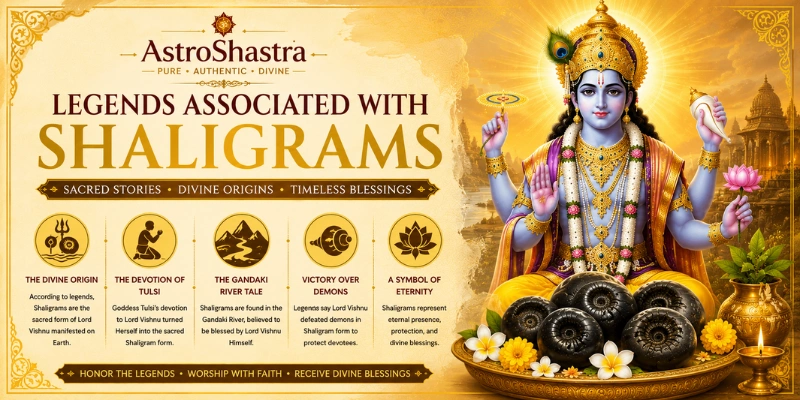
Legend of Shaligram
 Shaligram/Salagrama is an iconic in character. However in comparison, the linga may be a natural
object like the bana-linga found in the river Narmada, or carved by man in stone, gems
or clay or any material. But Salagramas are always only those which are naturally found
in the river Gandaki; they are never made by man.
Shaligram/Salagrama is an iconic in character. However in comparison, the linga may be a natural
object like the bana-linga found in the river Narmada, or carved by man in stone, gems
or clay or any material. But Salagramas are always only those which are naturally found
in the river Gandaki; they are never made by man.
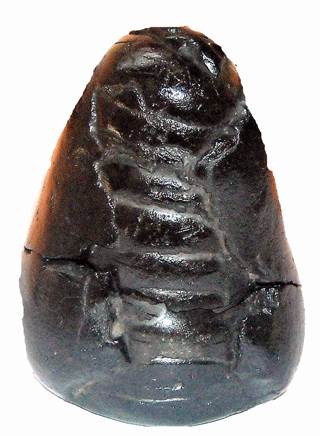
It is interesting to that the great Samkara (632-664 A.D.) mentions in his Vedanata-sutra-bhashya the worship of no other god other than that of Vishnu, and that too in his Salagrama aspect (1,2,7 yatha salagrama harih; 1,2,14 salagrama iva vishnoh; 1,3,14 yatha salagrame vishnuh sannihitah, tadvat), and not in iconic forms. There is a wide-spread belief that the aniconic salagrama must necessarily accompany the iconic representations; and the worship offered to the salagrama takes precedence in the worship offered at home or in temples. It is a fact that in the Vishnu shrines, salagramas are invariably placed in close contact with the mula-murti, which worship is offered. Even in the celebrated temple of Vengadam (Tirupati-Tirumalai), the group of salagramas always kept at the feet of the main deity in the sanctum partakes of the principal worship daily; administrating a ceremonial bath to the salagramas is an important detail.
Salagrama is actually the name of the village on the banks of the river Gandaki, where the holy stones are picked up. The name is derived from the hut (sala) of the sage Salankayana, who beheld the form of Vishnu in a tree outside his hut (cf. Varaha-purana). This hut was on the banks of the Gandaki, and it was in that particular spot that these sacred stones were found in abundance. The stones were therefore called Salagrama.
The river Gandaki is a very ancient river; and the geologists say that it existed even before the formation of the Himalayan ranges. It rises beyond the Himalayan ranges, probably in Tibet, and flows (in the north-south direction) into Nepal, which is the southern valley of the Himalayas, and India. The situation of the birth of the river is given as North 27 27 and East 83 56; it courses in the south-western direction, and joins Ganga in a place called Bhavatyapur in Bihar. It is an important tributary of the river Ganga. It is called Salagrami or Narayani in Uttar-pradesh. It was known to the Greek geographers as Kondochetts.
Understanding the Legend of Shaligram
Shaligram or Salagrama occupies a distinctive place in the sacred traditions surrounding Vishnu worship. The original account on this page emphasizes that Salagramas are naturally occurring stones associated with the Gandaki River and are distinguished from images or sacred forms made by human craftsmanship.
The tradition also connects Shaligram with the worship of Vishnu in an aniconic form. The historical and textual references preserved in the original article describe the place of Salagrama in temple and household worship and its association with ceremonial bathing and reverence.
Gandaki River and the Origin of the Name Salagrama
According to the traditional account presented here, the name Salagrama is associated with a place on the banks of the Gandaki where sacred stones were found. The page also preserves the story connecting the name with the hut of the sage Salankayana and the traditional belief that Vishnu was perceived there.
The Gandaki, also referred to in the article as Salagrami or Narayani in certain regions, is therefore an important geographical and sacred element in the Shaligram tradition.
Frequently Asked Questions About the Legend of Shaligram
What is the legend of Shaligram?
The legend of Shaligram refers to the traditional sacred stories and associations surrounding naturally occurring Salagrama stones, especially their connection with Vishnu worship and the Gandaki River.
Why is the Gandaki River associated with Shaligram?
The original tradition presented on this page identifies the Gandaki as the river associated with the naturally occurring sacred stones known as Salagrama or Shaligram.
Is Shaligram traditionally considered a man-made idol?
No. The traditional distinction preserved in the original article is that Salagramas are naturally found stones rather than forms carved or manufactured by people.
What is the significance of Salagrama in Vishnu worship?
The article describes Salagrama as an aniconic form associated with Vishnu and records its revered place in household and temple worship.
Explore Sacred Shaligram Shilas
Discover Shaligram categories and continue learning about their traditional forms, identification, worship and significance.
Explore Shaligram CollectionIdentification of Natural Shaligram
Puja and Mantras
How to keep Shaligram Shilas
Ledgends associated with Shaligrams
Benefits of Shaligram
Importance of Shaligram
Types of Shaligram
Types in Garud Puran
Types as in Praanatashanitantra
Shop Popular Shaligram Shilas
Genuine & Energized Divine Shaligram Shilas


Shop Popular Lucky Charms
Authentic Vedic Lucky Charms for Wealth, Protection, Success, Protection & Prosperity

Lucky Gajraj
Luck & Prosperity
Black Horse Shoe Ring
Protection
Evil Eye Pendant
Negative Energy
Shvetark Ganpati
Success & Wisdom
Kali Haldi
Wealth Attraction
Narmadeshwar Shivling
Divine Blessings
Red Chimri Beads
Good Fortune
White Chimri Beads
Peace & Harmony
Black Chimri Beads
Protection & Success
Supari Ganesha
Obstacle Removal
Black Horseshoe
Good Luck
Dakshinavarti Shankh
Prosperity
Bhimseni Kapur
Positive Energy
Brass Pyramid
Vaastu Energy
Guggal
Purification
Loban
Spiritual Cleansing
Red Chandan
Divine Rituals
Swastik Pyramid
Vaastu Harmony
Lakshmi Paduka
Wealth Blessings
Kali Raksha Pendant
Protection
Boat Nail
Business Success
Cross
Faith & Blessings
Parad Shivling
Spiritual PowerRudraksh Beads
Find the bestseller in Rudraksh Beads .







Rudraksh Pendants & Malas
Find the bestseller Rudraksh Pendants and Malas .




Rudraksh & Yantra Pendants
Find the bestseller Rudraksh & Yantra Pendants .