Pyramids in Vastu Shastra
Vastu pyramids are traditionally used as a remedial tool for addressing certain Vastu-related energy imbalances. Their placement, orientation and installation are considered important when applying pyramid-based Vastu correction.

What Is the Role of a Pyramid in Vastu Correction?
According to the traditional Vastu approach presented in this article, a building with defective Vastu can have a distorted energy field that may not be favourable for its inhabitants.
The traditional remedy described here is to introduce another independent and more powerful energy field within the structure in an effort to create harmony. Pyramids are therefore used as one of the remedial approaches for Vastu correction.
The pyramid is traditionally regarded as an energy generator, and its application is associated with correcting certain Vastu defects.
Understanding the Vastu Pyramid
A pyramid is essentially an object with four triangular sloping sides and a flat base. Its pointed tip is known as the apex.
According to the traditional description, energy released from the apex is considered hot in nature, while energy released from the base is considered cold in nature.
The pointed upper portion of the pyramid is traditionally called the apex.
The BaseThe flat lower portion forms the base of the pyramid.
Standard Alignment and Cross Alignment
The orientation of the pyramid is an important consideration in the traditional method described for Vastu correction.
Standard Alignment
When the four sides of the pyramid face the four cardinal directions, it is considered to be in the axis or standard alignment.
Cross Alignment
When the four sides face the south-west, north-west, south-east and north-east directions, the arrangement is described as cross alignment.
If defects of the north, east, west or south are involved, the traditional method recommends standard alignment. When cross directions are involved, cross alignment is recommended.
Why Plastic Pyramids Are Mentioned for Burial
The traditional method described on this page requires pyramids to be buried in the soil. Therefore, plastic pyramids rather than wooden pyramids are specified for this particular application.
Pyramids for Angular Defects in a Plot
Angular defects can arise when a corner of a plot is extended at a particular angle other than the north-east.
The normal procedure for correcting such a distorted plot is to construct compound walls in a way that creates the maximum possible rectangle or square from the irregular plot.
However, when such structural correction is not practical, pyramid correction may be considered as an alternative traditional remedial approach.
How Is a Vastu Pyramid Installed?
The following installation method is based on the traditional procedure described in the original Astroshastra article.
Prepare the Pit
Dig a square pit of approximately 30 cm × 30 cm with a depth of about 20 cm. The centre of the square is the point where the two lines intersect.
Place Marble Slabs
Place a white marble slab approximately 10 mm thick at the bottom of the pit and cover all four sides with marble slabs.
Locate the North Axis
Use a compass to locate the north axis. The apex of the pyramid should be positioned directly above the intersection point.
Cover the Pit
Cover the pit with coarse sand while allowing the apex of the pyramid to remain visible.
Observe the Arrangement
The original guideline states that improvement should occur in about two weeks; otherwise, the pyramid should be re-aligned.
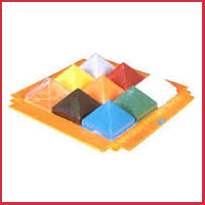
Pyramid Chips and Vastu Remedies
Pyramid chips are another form of pyramid-based Vastu remedy associated with the traditional approach to correcting energy-related defects.
Centre-Point Pyramid Correction
For large areas of land, correcting individual corners may not always be practical. The traditional approach therefore recommends centre-point correction using pyramids.
The idea behind installing a pyramid combination at the centre is based on the traditional view that the centre of a building is the point where forces converge and disperse.
After locating the centre of gravity of the plot, the traditional method described here recommends a combination of nine pyramids.
According to the original method, the pit should be covered with pebbles while the tips of the pyramids remain uncovered.
Important Points About Pyramid Vastu
Alignment Matters
The traditional method distinguishes between standard and cross alignment.
Direction Matters
Pyramid orientation is selected according to the type and direction of the Vastu defect.
Plot Shape Matters
Angular extensions can create situations where pyramid correction is considered.
Centre Correction
Large plots may be approached through traditional centre-point pyramid correction.
Not Sure Which Vastu Remedy Your Property Needs?
Vastu remedies should be selected according to the actual layout, directions, plot shape, entrances and other characteristics of the property. If you are considering pyramids or other Vastu corrections, get personalized guidance from Astroshastra Vastu Consultancy.
The information presented on this page describes traditional Vastu principles and remedies. Pyramid placement should be evaluated according to the specific property and its Vastu characteristics. For structural, construction, legal or engineering matters, consult the appropriate qualified professional.
Pyramids in Vastu – FAQs
What is a pyramid used for in Vastu?
According to the traditional approach described on this page, pyramids are used as a remedial tool for addressing certain Vastu defects and creating a more harmonious energy field.
What is standard alignment of a Vastu pyramid?
Standard alignment refers to positioning the four sides of the pyramid toward the four cardinal directions: north, east, south and west.
What is cross alignment of a pyramid?
Cross alignment refers to positioning the four sides toward the south-west, north-west, south-east and north-east directions.
Why are plastic pyramids mentioned for burial?
The traditional installation method described here requires pyramids to be buried in soil and therefore specifies plastic rather than wooden pyramids for that application.
Can pyramids be used for angular plot defects?
The traditional method described on this page states that pyramid correction may be considered when an angular plot defect cannot conveniently be corrected by creating a more regular rectangular or square plot boundary.
How are pyramids installed for Vastu correction?
The traditional procedure involves preparing a square pit, placing marble slabs, locating the north axis with a compass, positioning the pyramid apex correctly and covering the pit while leaving the apex visible.
Can pyramid correction be used for large plots?
The traditional approach described here recommends centre-point correction for large areas where correcting individual corners may not be practical.
Can Astroshastra provide Vastu Consultancy?
Yes. Astroshastra provides Vastu Consultancy for personalized evaluation of property layouts, directions, plot characteristics and appropriate traditional Vastu considerations.


